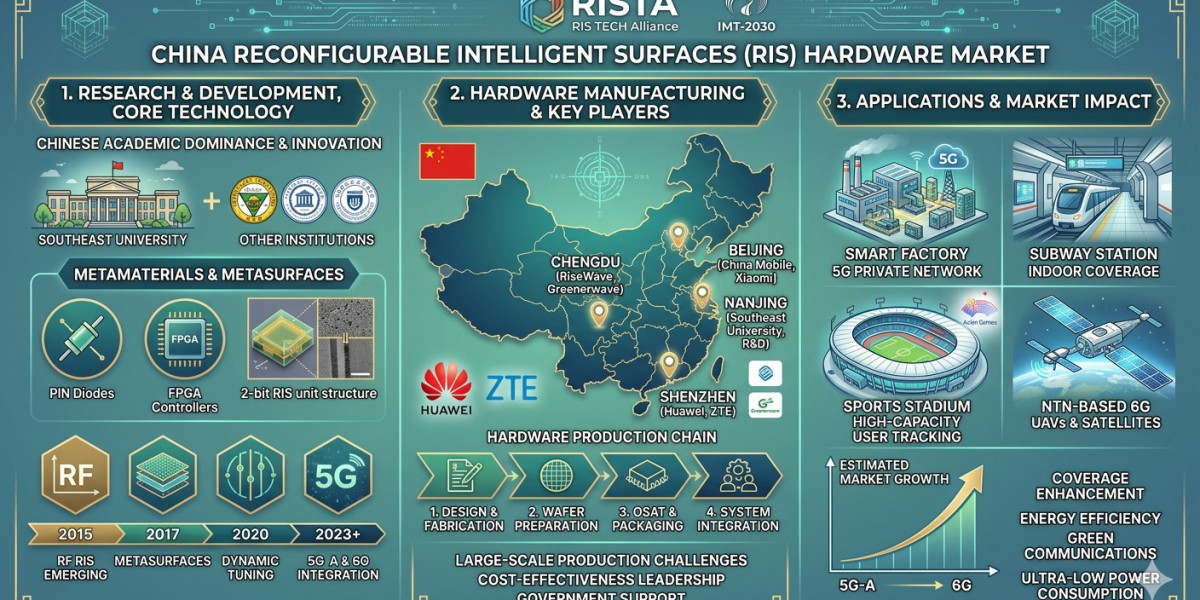

The China Reconfigurable Intelligent Surfaces (RIS) Hardware Market is gaining strong momentum as the country accelerates investments in next-generation wireless communication technologies. RIS hardware, often described as smart surfaces, enables dynamic control of electromagnetic waves, enhancing signal strength, coverage, and efficiency. With China’s rapid push toward 6G technology, the demand for advanced RIS components is increasing significantly, positioning the market for substantial growth over the coming years.
The evolution of RIS hardware is closely tied to innovations in beamforming system design and antenna array technology, which allow for precise signal direction and improved network performance. These advancements are crucial for supporting high-speed data transmission, ultra-low latency, and reliable connectivity across urban and rural environments. As telecom operators and technology providers invest in intelligent infrastructure, RIS hardware is emerging as a key enabler of future-ready communication systems.
Moreover, the integration of RIS solutions into smart cities, industrial automation, and connected devices is transforming how signals are managed and optimized. The rising adoption of IoT ecosystems and autonomous technologies is further boosting the need for programmable surfaces that can adapt in real time to changing network conditions. This is driving innovation in hardware design, making RIS more energy-efficient, scalable, and cost-effective.
The Industrial Logic Integrated Circuit Market is playing a complementary role by providing essential components that support the control and processing capabilities of RIS systems. At the same time, the Europe Audio Equipment Market highlights the broader trend of advanced signal processing technologies, which indirectly contributes to the development of sophisticated RIS hardware solutions.
China’s strong manufacturing ecosystem, combined with government initiatives promoting digital transformation and advanced communication networks, is accelerating the deployment of RIS hardware. Companies are focusing on developing compact, high-performance modules that can be easily integrated into existing infrastructure. This includes enhancing compatibility with emerging network standards and improving the scalability of RIS deployments across different use cases.
In addition, strategic collaborations between telecom providers, research institutions, and hardware manufacturers are fostering innovation in the market. These partnerships are aimed at optimizing RIS performance, reducing implementation costs, and expanding application areas. As a result, the market is expected to witness continuous advancements, particularly in the context of next-generation network architectures.
FAQs
1. What are Reconfigurable Intelligent Surfaces (RIS)?
RIS are engineered smart surfaces that can control and manipulate electromagnetic waves to improve signal quality, coverage, and efficiency in wireless communication systems.
2. How does RIS hardware support 6G technology?
RIS hardware enhances signal propagation through advanced beamforming systems and antenna array technology, enabling faster speeds, lower latency, and improved network reliability essential for 6G.
3. What industries benefit from RIS hardware in China?
Industries such as telecommunications, smart cities, industrial automation, and IoT ecosystems benefit significantly from RIS hardware due to improved connectivity and adaptive signal management.
Japan Investment Banking Market
Mexico Investment Banking Market
South Korea Investment Banking Market
Spain Investment Banking Market