
Hydraulics play a vital role in powering modern industries across the United States. From construction equipment and manufacturing plants to automotive systems and aircraft, hydraulic technology is everywhere. But how do hydraulics work?
In simple terms, hydraulics use liquid under pressure to generate force and motion. This allows machines to lift heavy loads, perform precise movements, and operate efficiently in demanding environments.
For a deeper understanding, you can also explore your detailed guide here:
https://www.harvardfiltration.com/how-do-hydraulics-work/
What Is a Hydraulic System?
A hydraulic system is a technology that uses fluid (usually oil) to transmit power. Unlike mechanical systems that rely on gears or electrical systems that depend on wires, hydraulics use pressurized liquid to perform work.
Hydraulic systems are popular in U.S. industries because they are:
- Powerful
- Reliable
- Easy to control
- Highly efficient
The Basic Principle Behind Hydraulics
Hydraulics work on a simple scientific principle:
Pressure applied to a confined liquid is transmitted equally in all directions.
F=P×AF = P \times A
This means:
- If you apply pressure at one point, it spreads throughout the fluid
- The force can be increased by using a larger surface area
Simple Example
Imagine pressing a small piston connected to a larger piston:
- A small force is applied on the small piston
- The pressure travels through the fluid
- The larger piston produces a much bigger force
This is how hydraulic systems can lift heavy objects with minimal effort.
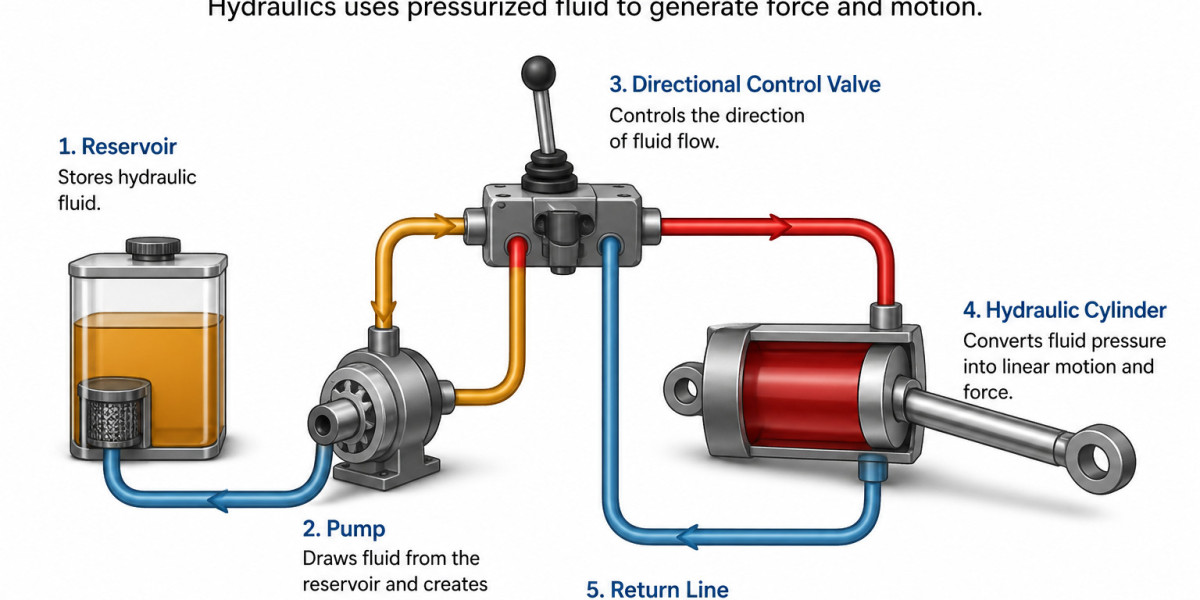
Main Components of a Hydraulic System
Every hydraulic system used in the United States includes several key components:
1. Reservoir (Tank)
Stores the hydraulic fluid and helps cool and filter it.
2. Hydraulic Pump
Converts mechanical energy into hydraulic energy by moving fluid.
3. Hydraulic Fluid
Transfers power, lubricates components, and reduces wear.
4. Valves
Control the direction, pressure, and flow of fluid.
5. Actuators (Cylinders or Motors)
Convert hydraulic energy into mechanical motion.
6. Pipes and Hoses
Carry fluid between different parts of the system.
Step-by-Step: How Hydraulics Work
Here’s how a hydraulic system operates in real-world applications:
Step 1: Fluid Storage
Hydraulic fluid is stored in the reservoir.
Step 2: Pressurization
The pump draws fluid and increases its pressure.
Step 3: Flow Control
Valves direct the pressurized fluid to the required area.
Step 4: Force Creation
The fluid pushes against a piston inside a cylinder, creating movement.
Step 5: Return Cycle
The fluid returns to the reservoir and the process repeats.
Types of Hydraulic Systems
Hydraulic systems used in U.S. industries are generally divided into:
Open-Loop Systems
Fluid flows from the pump to the actuator and returns to the reservoir.
Closed-Loop Systems
Fluid circulates continuously without returning to a reservoir.
Hydrostatic Systems
Use fluid pressure directly to generate motion.
Hydrodynamic Systems
Use fluid velocity to transfer energy.
Real-Life Applications in the United States
Hydraulics are used in a wide range of industries:
Construction Equipment
Excavators, loaders, and cranes rely on hydraulics for lifting and digging.
Automotive Systems
Hydraulic brakes and power steering systems ensure safety and control.
Manufacturing Industry
Hydraulic presses shape metals and materials with high precision.
Aerospace Industry
Aircraft use hydraulics for landing gear and flight control systems.
Agriculture
Tractors and harvesters depend on hydraulic systems for efficient operation.
Advantages of Hydraulic Systems
Hydraulics are widely used in the U.S. because of their many benefits:
- High Power Output – Can lift extremely heavy loads
- Precision Control – Smooth and accurate movement
- Compact Design – Delivers high power in small spaces
- Durability – Works well under extreme conditions
- Flexibility – Suitable for multiple industries
Limitations of Hydraulics
Despite their advantages, hydraulic systems also have some drawbacks:
- Risk of fluid leakage
- Regular maintenance is required
- Sensitive to contamination
- Initial setup cost can be high
Importance of Hydraulic Filtration
One of the most critical aspects of a hydraulic system is filtration. Clean hydraulic fluid ensures:
- Longer equipment life
- Better system performance
- Reduced downtime
- Lower maintenance costs
Contaminated fluid can damage pumps, valves, and cylinders, leading to expensive repairs.
Future of Hydraulics in the U.S.
Hydraulic technology is evolving rapidly with modern innovations:
- Smart hydraulic systems with automation
- Energy-efficient designs
- Environmentally friendly fluids
- Integration with electric systems
These advancements are making hydraulic systems more sustainable and efficient for future industrial needs.
Conclusion
Hydraulics work by using pressurized fluid to transfer energy and generate force. This simple yet powerful concept allows machines to perform heavy-duty tasks with ease and precision.
From construction sites to manufacturing plants across the United States, hydraulic systems continue to be an essential part of modern engineering.
If you want to learn more, visit your full guide here:
https://www.harvardfiltration.com/how-do-hydraulics-work/
FAQs
1. What fluid is used in hydraulic systems?
Most systems use specially formulated hydraulic oil that provides lubrication and efficient power transfer.
2. Why are hydraulics so powerful?
Because pressure applied to fluid is distributed evenly, allowing small forces to generate large outputs.
3. Where are hydraulics commonly used?
They are used in construction, automotive, aerospace, agriculture, and manufacturing industries.
4. How do you maintain a hydraulic system?
Regular fluid checks, filtration, and inspection of components help maintain system performance.